
Revised quotations: why the Project Manager asks and how to respond
When a Project Manager can instruct a revised NEC quotation, what good reasons look like, how long it takes and how to reply without wasting three weeks.
On this page
A revised quotation is the Project Manager's way of saying "have another go". The Project Manager is the person the Client appoints to run the contract day to day. Under clause 62.4 they may only ask for one after explaining why, and you then have three weeks to resubmit. The rule is the same in NEC3 and NEC4. It is one of three permitted replies to your quotation, alongside accepting it or doing the assessment themselves.
In plain English
They have to give reasons, you get three weeks to fix or defend your numbers, and the process starts a new reply period when you resubmit.
Which reply should they choose?
Choosing is a matter of judgement, but these pairings are typical:
| Situation | Likely reply | Reason |
|---|---|---|
| A rate is wrong or a figure missed, easily fixed | Revised quotation | You keep the assessment with little effort |
| Disagreement on facts that more evidence could settle | Revised quotation | You can supply the proof |
| A different method is wanted | Talk first, then alternatives or a revision | Clause 62.1 is built for this |
| Already round twice, no movement | Their own assessment | Another round only adds time |
| Dispute of principle | Their own assessment | It sets the position, and you can use the dispute route |
| Programme missing or faulty | Their own assessment | Clause 64.1 allows it anyway |
What useful reasons look like
The contract asks only for an explanation, but a reason you can act on saves everyone time. Compare two versions from an imagined culvert job:
- Weak: "The price is too high and does not reflect Defined Cost."
- Useful: "Your excavator hire runs for 12 weeks, but the programme shows an 8-week dig. The groundwater allowance overlaps with the assumption in our instruction. Please correct both."
Common valid points include costs outside the Schedule of Cost Components, resources that do not match the programme, a wrongly applied Fee percentage or dividing date, risk allowances with no basis, delay not shown on the programme, and an early warning statement under 61.5 that is not reflected. "We only have budget for half" is not a reason, and neither is an order from the Client to cut the number.
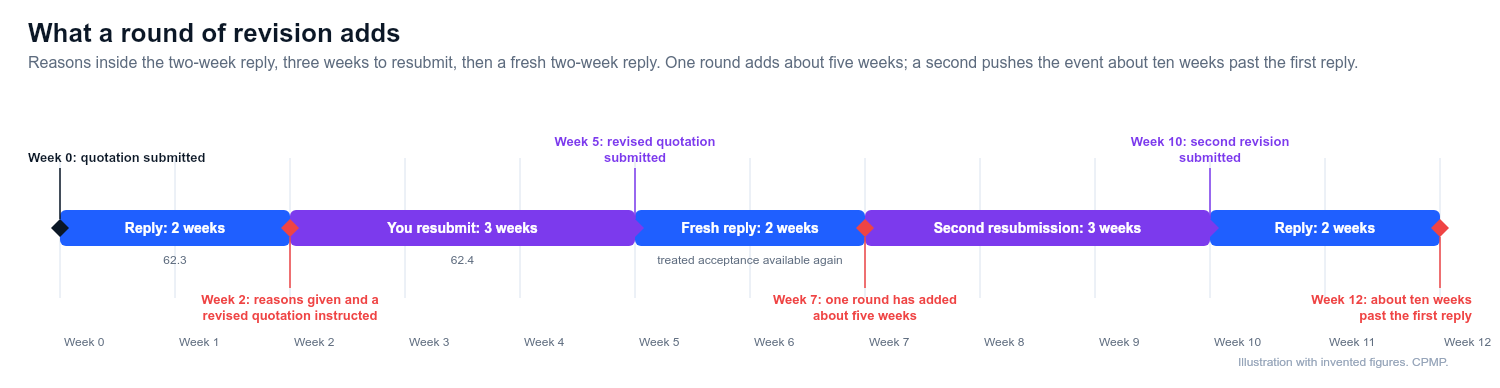
The timeline
- They give reasons and instruct inside the two-week reply period (62.3).
- You resubmit within three weeks.
- A fresh two-week reply period runs, and treated acceptance is available again.
A full round can therefore add around five weeks. A second round pushes the event about ten weeks past the first reply, by which point forecasts may have turned into facts, even though the dividing date stays put. The contract sets no cap on rounds, but one revision, and rarely two, is a sensible limit before they assess.
What to do when you receive one
- Read the reasons properly. If they are right, correct the figures. If not, say why in your resubmission and keep your basis.
- Never resend the same document with a new date. That gives them grounds to say the event was not correctly assessed and to justify their own assessment under 64.1.
- If the reasons are unclear, ask. A short call is cheaper than a three-week cycle.
- If you fear where this is heading, write down what you think the right answer is. See what happens when the Project Manager assesses.
Proposed instructions
In NEC4, revised quotations also apply to a proposed instruction. The Project Manager gives their reasons along with the instruction under 65.2.
Related guides
- Quotations for compensation events
- Treated acceptance when no reply comes
- Compensation event mistakes
- The Project Manager rejected my quotation
This guide is general information, not legal advice. Check it against your contract.