
When the Project Manager assesses a compensation event instead of you
The four situations in NEC clause 64 where the Project Manager assesses a compensation event, how long they have and what you can do if they fail.
On this page
Clause 64 hands the assessment of a compensation event to the Project Manager, the person the Client appoints to run the contract day to day, in four situations. A compensation event is an event the Client carries the risk for, so your price and dates are reassessed. It can feel like a penalty, but it is better seen as a way to make sure every event reaches an answer even when the quotation stage stalls. The clause numbers are the same in NEC3 and NEC4.
In plain English
If you do not quote properly or on time, or your programme is a problem, the Project Manager can price the event themselves. If they then fail to act, your own quotation can end up treated as accepted.
The four triggers (64.1)
| Trigger | Illustration |
|---|---|
| You have not sent your quotation and details in time | Instructed in week 10, nothing received by week 13 |
| They decide your quotation was wrongly assessed and do not ask for a revision | You priced bill rates instead of Defined Cost, after one failed round |
| You were required to provide a programme or alterations and did not | No revised programme since the last was due |
| They have not accepted your latest programme, for a reason the contract gives | It does not show how Key Dates will be met |
Their reply to a quotation must say they will make the assessment. In the second case, they are choosing it over a revised quotation.
Which programme they use
Clause 64.2 covers this. If there is no Accepted Programme, or you failed to provide a required programme or alteration, the Project Manager uses their own view of how the rest of the work will run. The NEC4 subcontract adds the case where the latest programme was not accepted for a stated reason, so check the equivalent wording in your own NEC4 ECC.
For you, that means your time entitlement rests on someone else's picture of your job. It is one of the best reasons to keep a programme accepted and current.
How long they have
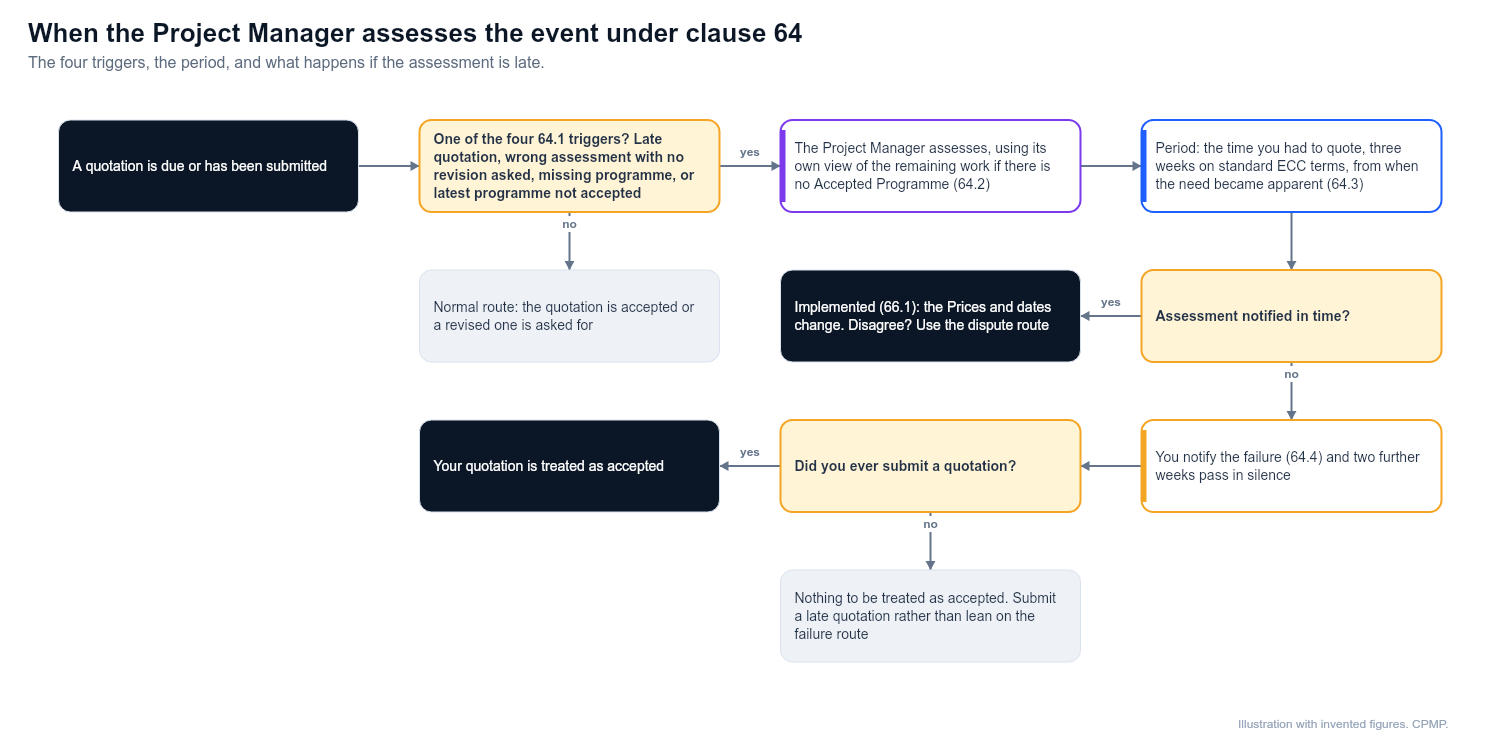
Under 64.3 their period matches the quotation period, three weeks on standard ECC terms, and starts when the need for the assessment became apparent. That date is vaguer than most, so ask them to state it:
- For a late quotation, it is when your quotation period ended.
- For a rejected one, normally the date of the reply saying they will assess.
If they fail to assess in time, you can notify the failure under 64.4. If nothing happens within a further two weeks, your quotation counts as accepted. Say which quotation you propose if you sent more than one. See treated acceptance.
There is a catch. If you never quoted at all, there is nothing to be treated as accepted. The practical fix is to submit a late quotation rather than lean on the failure route.
What a fair assessment contains
- The same clause 63 rules as a quotation.
- Details, since 64.3 requires them: the Defined Cost build-up, Fee, risk allowances and the delay with its programme basis.
- The information relied on, including any record you have not seen.
- Any early warning statement.
It should not be a bargaining position or the lowest conceivable number. A clear assessment is also the first thing an adjudicator will read in a dispute.
After notification
Their notification of the assessment implements the event (66.1, or 65.1 in NEC3). The Prices, Completion Date and Key Dates change then, whether or not you agree. If you disagree, use the contract's dispute route, which has time limits: see time limits for disputes.
Related guides
- Quotations for compensation events
- Implementing a compensation event
- What is the Accepted Programme
- Who assesses when there is no accepted programme
This guide is general information, not legal advice. Check it against your contract.