
NEC dispute deadlines under W1 and W2, with a diary method
The deadlines that apply when you dispute something under NEC W1 or W2, in NEC3 and NEC4, plus the final assessment windows and a simple way to diarise them.
On this page
If you are on W2, you can start adjudication whenever you want. If you are on W1, the contract sets short deadlines, and missing one can close the door on adjudication and the tribunal altogether. On both, anyone unhappy with an Adjudicator's decision has four weeks from being told of it to give notice that the matter is going to the tribunal.
The NEC4 figures below come from the NEC4 subcontract wording, which mirrors the main Engineering and Construction Contract (ECC). Periods vary between forms and many contracts are amended, so treat this as a map and confirm each date in your own contract. For the wider picture see how NEC disputes work.
W2: the Act applies
Under W2 nothing stops you giving notice of adjudication on day one or day three hundred. After that the sequence is the same in NEC3 and NEC4:
- The Adjudicator has 3 days to confirm they will act.
- You must send the referral within 7 days of your notice.
- The other side may add information for 14 days after the referral.
- The Adjudicator decides within 28 days of the referral, and that can be stretched.
- Anyone dissatisfied has 4 weeks from being told the decision to notify the tribunal.
NEC4 also lets the two sides agree to a Senior Representatives stage first (a week for statements, then up to three weeks of talks). NEC3 has no such stage.
W1: the Act does not apply
W1 is where the strict clocks live. Here is the NEC4 subcontract version, followed by what differs in NEC3.
NEC4
- If you disagree with what the contract manager did or failed to do, you must go to the Senior Representatives within 4 weeks of finding out.
- If something has been treated as accepted, the paying side has 4 weeks to refer. The same 4 weeks applies to a Defined Cost assessment treated as correct.
- Any other matter can be referred once the dispute exists.
- Statements of case take 1 week, and the talks run no more than 3 weeks, ending in a list of issues.
- You then have 2 weeks to give notice of adjudication, and 2 more to send the referral.
- The information period is 4 weeks, the decision follows within 4 weeks of its end, and the tribunal notice is due within 4 weeks after that decision.
NEC3
- There are no Senior Representatives. For a disputed action or inaction you notify within 4 weeks of finding out, then refer to the Adjudicator 2 to 4 weeks later.
- A quotation that is treated as accepted follows the same notify-then-refer pattern.
- Any other matter is referred 2 to 4 weeks after you notify.
- The information period, decision window and tribunal notice match NEC4.
Under W1, a dispute that misses its notice or referral deadline cannot later go to the Adjudicator or the tribunal. An extension only works if it was agreed before the date expired.
Final amounts have their own clock
NEC4 clause 53 adds a further limit under W1 and W2 alike: the final assessment becomes conclusive unless someone acts in time. In the subcontract wording:
- Challenge the assessment within 4 weeks. Under W1 that means the Senior Representatives; under W2 you may use them or the Adjudicator.
- Anything the talks left unresolved goes to the Adjudicator within 3 weeks of the list.
- A decision you dislike goes to the tribunal within 4 weeks.
So even the "any time" freedom of W2 runs out for the final account. See final assessment and disagreeing with the final assessment.
A dated example on NEC4 W1
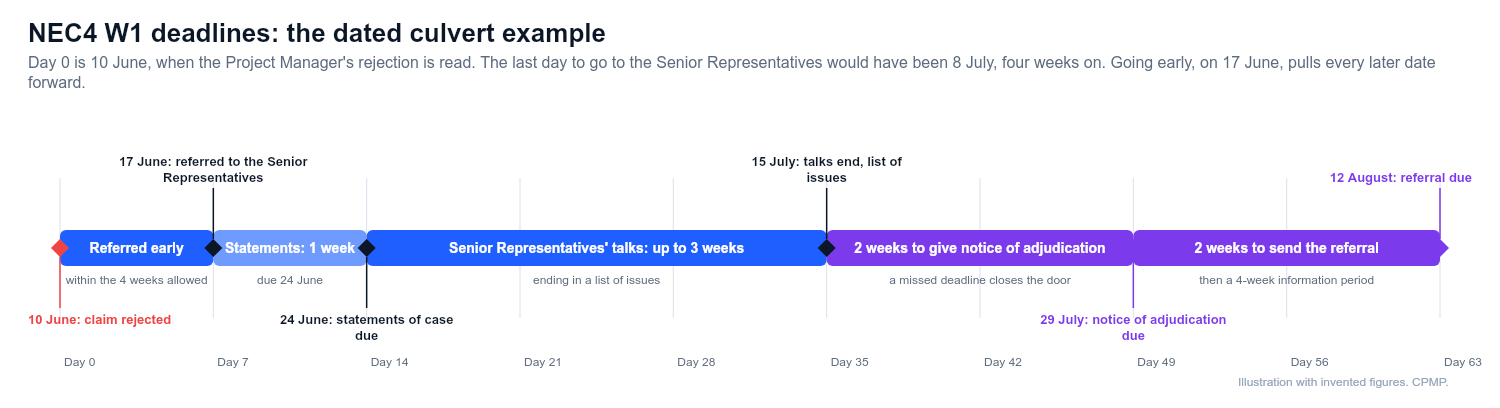
Imagine a fictional culvert contract outside the Act. On 10 June the Project Manager (the person the Client appoints to run the contract day to day) rejects your claim and you read it that afternoon.
- The last day to go to the Senior Representatives is 8 July.
- You go early, on 17 June, so statements of case are due 24 June.
- Talks finish by 15 July at the latest, producing the list of issues.
- Notice of adjudication is then due by 29 July, and the referral by 12 August.
Always rebuild the dates from your own wording and check how the weeks fall.
Keeping the dates safe
- Start the clock from the day a decision arrives, not from the day you decide you are unhappy.
- Record when you became aware and how you know.
- Give one person ownership of the list and review it at every commercial meeting.
- Ask for extensions in writing, well ahead, and get written agreement.
- Remember that talking does not stop any of these clocks unless the contract or a signed agreement says it does.
Other limits sit outside the contract
The general law sets limitation periods for starting legal proceedings, and they can depend on whether the contract was a deed. Ask a lawyer how they fit. Compensation event notices also have a time bar that may have passed before any dispute arises: see missing the eight-week deadline.
Related guides
- Dispute time limit passed: what now?
- Adjudicate or negotiate?
- Adjudication under NEC
- Option W2 explained
This guide is general information, not legal advice. Check it against your contract.