
When does NEC retention come back to you?
How retention is released under Option X16, the two release points, how NEC3 and NEC4 differ, and what to diarise so the money actually arrives.
On this page
Your Completion certificate is out and you want to know when the money held back will reach you. The answer depends on whether Option X16 is in your contract and how your edition words the second release.
The short answer
Under Option X16, retention (a percentage of what you are owed that the Client holds back as security) is released in two halves. The first half comes back in the assessment after Completion of the whole works, or after the Client takes over the whole if that happens sooner. The second half follows the Defects Certificate stage. There is no separate invoice for it: the release flows through the normal payment assessments. Because Clients amend this Option often, read your own X16 wording before you promise anyone a date.
What to do, step by step
- Check which edition you are on and whether X16 has been amended. The clause numbers are the same, but the trigger for the second half differs.
- Compare the two stages:
| Stage | NEC3 ECC | NEC4 subcontract text (2019 amendments) |
|---|---|---|
| First half | Assessment at Completion of the whole, or earlier take over of the whole | Assessment following Completion of the whole, or take over of the whole if earlier |
| Second half | After the Defects Certificate is issued | Once the date the Defects Certificate is due has passed |
- Read X16.2 in your NEC4 ECC against that table. NEC issued amendments, so the date of your copy matters.
- Work out when the Defects Certificate is due as soon as Completion is certified. It depends on the defects date plus the last defect correction period (44.3).
- Diarise the two assessments that follow those triggers.
- Keep applying for payment before each assessment date. In NEC4, if you do not apply, the amount due is limited under 50.4, which could hold up the release.
- Check the retention line on every payment certificate against your own sums. If it is wrong, ask for a correction under 50.6.
What to record
- The Completion date and the take over date, if different.
- Your calculation of held retention at each assessment.
- The defects date and last correction period, and the resulting due date for the Defects Certificate.
- Written requests for correction and the replies.
What not to do
- Do not wait for the Client to volunteer the release. Nothing in the clause needs a request, but finance teams follow certificates, so mention the retention line in your covering email.
- Do not accept "defects are still open" as a reason to keep all of it. X16 does not say that. Open Defects are dealt with through correction periods.
- Do not assume a finished section releases anything. The wording refers to the whole of the works, even with sectional completion under Option X5, unless a Z clause says otherwise.
- Do not accept a demand to agree the final account first, unless a Z clause makes that a condition.
When to get help
Ask your commercial manager if the certificate leaves out the release, or if retention seems to be held longer than X16 allows. Retention is not ring-fenced in a trust account under standard wording, so take legal advice quickly if the Client's finances worry you. A retention bond, if the contract permits one, replaces held cash altogether.
Example
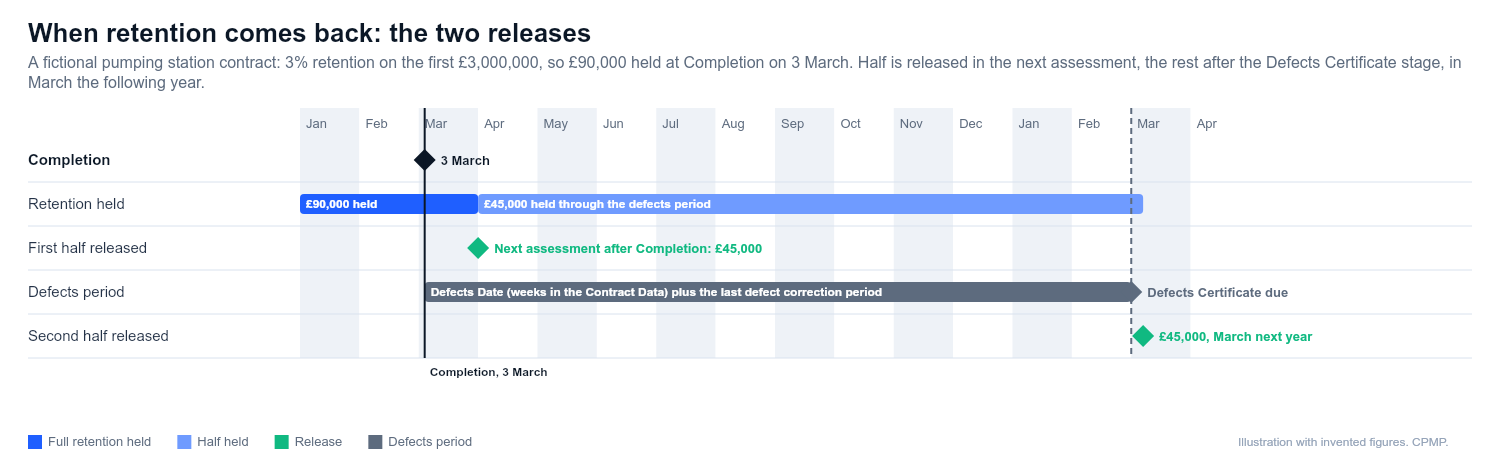
A fictional pumping station contract has retention of 3% on the first £3,000,000 of work done. That is £90,000 held at Completion on 3 March. The next assessment returns £45,000. The second £45,000 is due in the assessment after the Defects Certificate stage, in March the following year. Your diary shows both dates from the day Completion is certified.
Related guides
- Retention under NEC
- Completion, take over and the defects date
- The defects certificate explained
- Making an NEC payment application
This guide is general information, not legal advice. Check it against your contract.