
The NEC4 final assessment and the four-week window to challenge it
How the NEC4 final assessment settles the final account, when it becomes conclusive, and the dispute deadlines you need in your diary.
On this page
On an NEC4 contract, the final account is not left to drift. The Project Manager (the person the Client appoints to run the contract day to day) must issue a final assessment within a fixed time, and once it is issued it can become the last word on what you are owed unless you challenge it in time. If you are the contractor, this is the date you cannot afford to miss.
The time allowed is four weeks after the Defects Certificate, or thirteen weeks after a termination certificate. The rules are in clauses 53.1 to 53.4. NEC3 has no equivalent step: its clause 53 deals with the Contractor's share on target contracts.
What each clause does
| Clause | Effect |
|---|---|
| 53.1 | The Project Manager assesses the final amount due, gives details and certifies any final payment in the time allowed |
| 53.2 | If the Project Manager is late, you may issue your own assessment with details |
| 53.3 | An assessment issued in time settles the final amount as conclusive evidence, unless a party follows the listed dispute steps |
| 53.4 | Where the figure is changed by agreement or an Adjudicator's decision that is not taken on to the tribunal in time, the changed figure becomes conclusive |
The subcontract form differs in places. It allows fourteen weeks after termination, and payment is due within three weeks of the assessment unless the Subcontract Data says otherwise. Read your own wording, including Option Y(UK)2, which fixes final payment dates its own way.
The challenge window
Using the NEC4 subcontract text, which follows the ECC numbering, the sequence is:
- Raise the dispute. Within four weeks of the assessment being issued, refer it to the Senior Representatives. Under Option W2 you may go to the Adjudicator instead on the same timing.
- Unresolved points. Refer them to the Adjudicator within three weeks of the list of issues being produced, or the date it should have been.
- Unhappy with the decision? Go to the tribunal within four weeks of that decision.
Your own Option W1, W2 or W3 holds the detail, so read it alongside.
Example: a fictional substation fence job
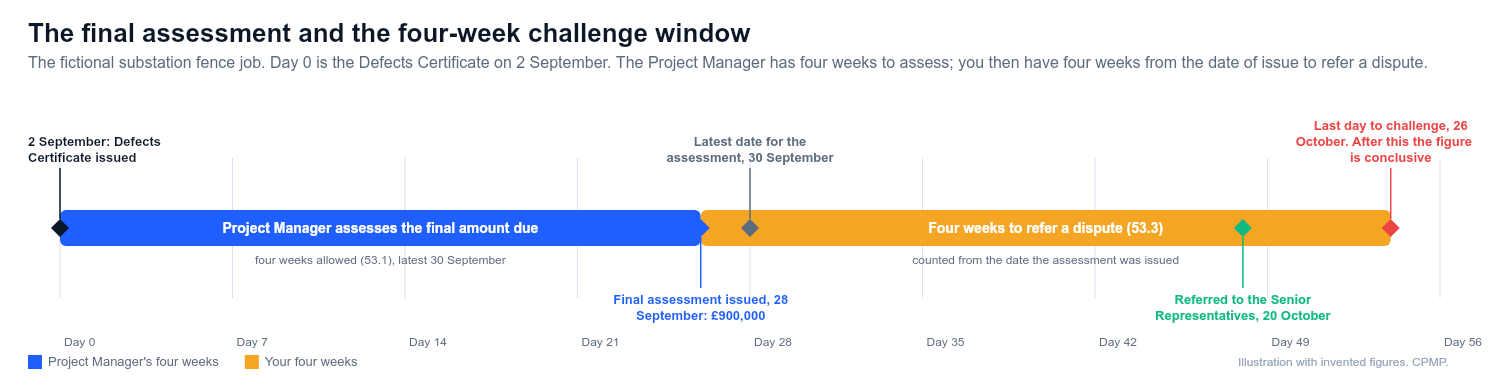
The Supervisor issues the Defects Certificate on 2 September. The Project Manager must assess by 30 September and does so on 28 September: final amount due £900,000, of which £880,000 has been paid, leaving a final payment of £20,000.
You think a £10,000 compensation event was missed. Four weeks from 28 September is 26 October, so that is your deadline. You refer the point to the Senior Representatives on 20 October, and they agree £6,000. The assessment is changed under 53.4 and the new figure becomes conclusive.
Had you done nothing by 26 October, the assessment would have become conclusive at £900,000 and the £10,000 would have gone.
If the Project Manager is late
You are not stuck. You can issue your own assessment, with details. If the Project Manager agrees, payment follows. If not, the dispute steps remain open to either side. Whether your assessment is also conclusive turns on the words "issued within the time stated" in your wording, so take advice if it matters.
What people get wrong
- Treating four weeks as a soft target. It is a contract date with consequences.
- Waiting for every item to be settled. NEC4 does not move the date for open compensation events, so clear them during the defects period.
- Holding a dispute back "for later". After the window closes, the whole figure may be shut, not just one line.
- Assuming NEC3 works the same way. Without a Z clause, it has no conclusive step in the core clauses.
In plain English
The final assessment is a one-shot figure. If you think it is wrong, you have about a month to say so formally.
Related guides
- We disagree with the final assessment
- Time limits for NEC disputes
- The Defects Certificate explained
- Adjudication under NEC
This guide is general information, not legal advice. Check it against your contract.