
NEC delay damages: how they are charged, reduced and repaid
How Option X7 delay damages work in the payment cycle, what happens when the Completion Date moves or part of the works is taken over, and common errors.
On this page
Delay damages on an NEC contract exist only if Option X7 has been chosen. Where it has, you pay the daily rate shown in the Contract Data (the part of the contract where project figures are filled in) for each day between the Completion Date and the earlier of Completion or the Client taking over the works. In NEC4, as amended in 2020, a termination certificate also ends them.
If you are the contractor, the practical points are: the rate is fixed in advance, the money comes out of your payments without a separate invoice, and the Completion Date it runs from must be the current one.
The three clauses
- X7.1: the daily charge starts on the Completion Date and stops at Completion or take over.
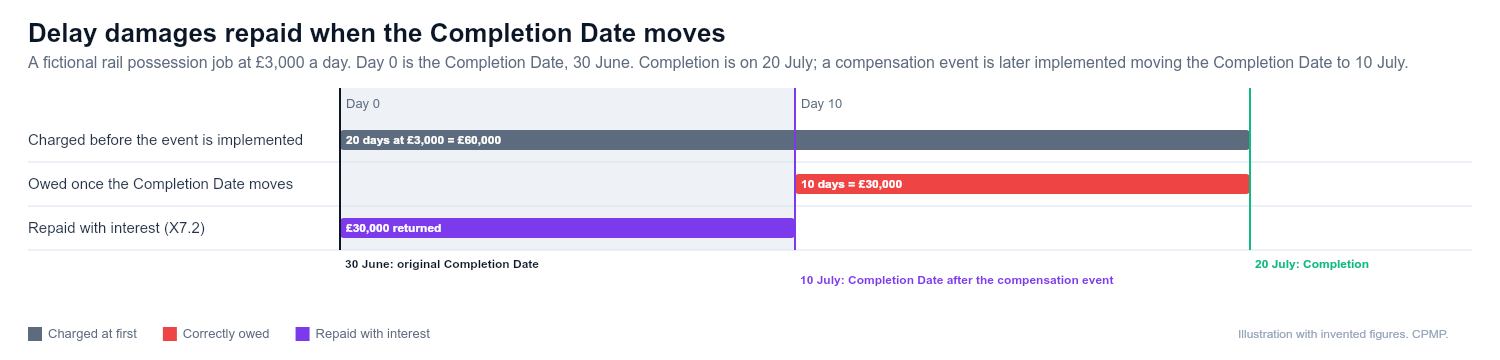
- X7.2: if the Completion Date later moves, for example through a compensation event, any overpaid damages come back to you with interest at the Contract Data rate. The repayment date counts as an assessment date.
- X7.3: if the Client takes over part of the works early, the daily rate falls by the Project Manager's assessment of the benefit to the Client of that part.
NEC3 and NEC4 share these figures. If Option X5 (sectional completion) is used, sections may each have their own rate, so check the data section by section.
How they reach your payments
Delay damages are a sum payable by you, so they sit among the deductions in the amount due set out in clause 50. They start reducing the certified amount at the first assessment after the Completion Date goes by with the works unfinished. Because the certificate already shows the deduction, the payer does not need a pay less notice for a sum that is correctly included.
Example: a rail possession job
A fictional contract, £3,000 a day, Completion Date 30 June.
| Event | Days charged | Charged to date |
|---|---|---|
| Completion on 20 July | 20 | £60,000 |
| A compensation event is implemented moving the Completion Date to 10 July | Should be 10 | £30,000 correct |
| Repayment | £30,000 returned with interest |
The repayment is a contract right, not a favour. This is a good reason to chase the Project Manager to assess compensation events promptly: late assessment can mean an interest bill.
When part is taken over
Suppose the Client starts using a station forecourt on 5 July while the platform works continue to 20 July. The Project Manager assesses the forecourt as providing, say, 25% of the benefit still outstanding. From 5 July the rate becomes £2,250.
- 30 June to 5 July: 5 days at £3,000 = £15,000.
- 5 July to 20 July: 15 days at £2,250 = £33,750.
- Total: £48,750.
The test is benefit to the Client, not value or floor area, so a small but vital part can cut the rate considerably. Keep a note of the Project Manager's reasoning.
Common questions
- The rate is blank, or X7 was not chosen. Whether the Client can claim general damages instead is a legal question about your exact wording. Take advice.
- Does the planned Completion date on the programme matter? No. The Completion Date in the contract is what counts, and terminal float (spare time before it) does not alter that.
- What about a missed Key Date? That has its own rule at clause 25.3. Delay damages concern Completion.
- What if Completion is disputed? Damages run to the day Completion actually occurred, not the date a certificate was issued.
What people get wrong
- Deducting damages when no Option X7 applies.
- Using the tender Completion Date instead of the current one after implemented events.
- Forgetting that take over before Completion also stops the clock.
- Not repaying the interest when dates move.
In plain English
Delay damages are a pre-agreed daily charge for finishing late. Check that the start date is current, the finish date is right and any early hand-over has been reflected.
Related guides
- X7: delay damages option
- Delay damages have been deducted: can we challenge them?
- Key dates and sectional completion
- Completion, take over and the defects date
This guide is general information, not legal advice. Check it against your contract.