
The Client missed the pay less notice deadline: what you can do
What a missed pay less notice means for payment under NEC Option Y(UK)2, how to check the dates, and how to protect your position.
On this page
The certificate says one figure, the payer wants to pay less, and no pay less notice arrived in time. You want to know whether they can still hold money back.
The short answer
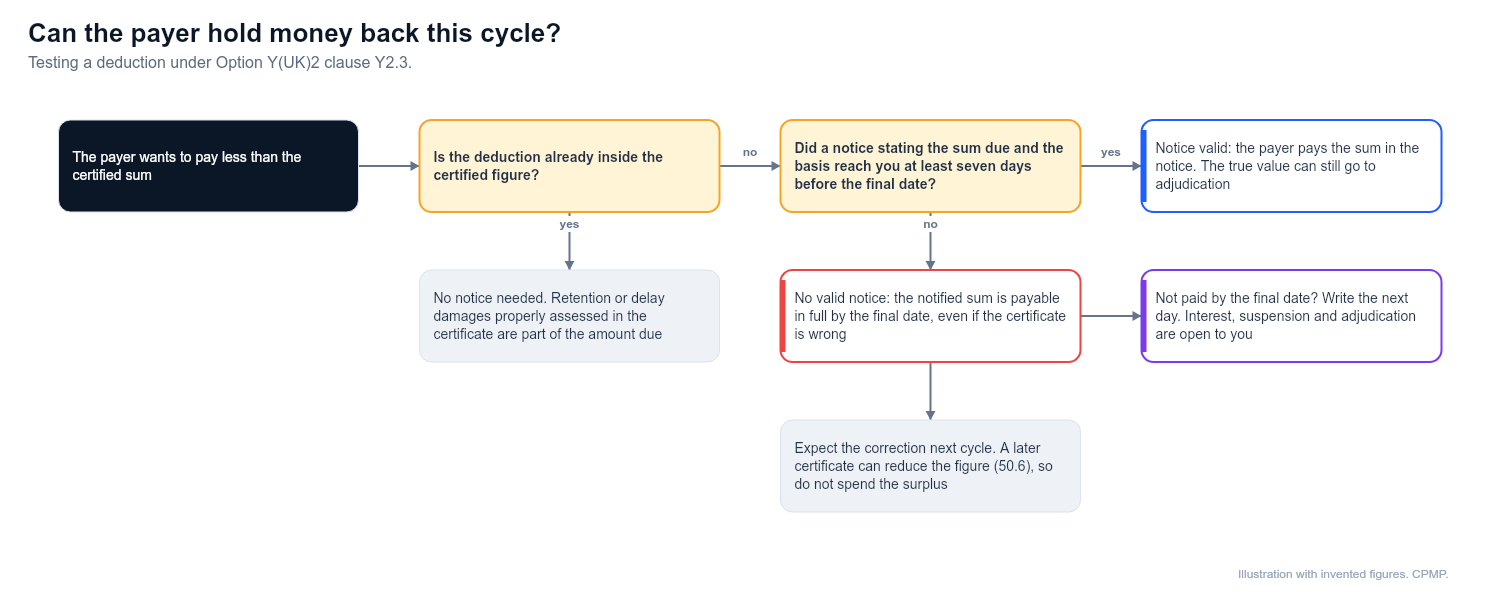
Generally, no, not for this payment. The payer must pay the notified sum in full by the final date, even if the certificate is wrong. A missed notice costs them the right to withhold this cycle, but it does not settle what is finally owed, so any overpayment can usually be recovered later. The rule sits in clause Y2.3 of Option Y(UK)2, present in NEC3 and NEC4, and reflects the Construction Act. Without that Option the Act may still apply.
What to do, step by step
- Count the dates. Y2.2 gives the due date, and the final date for payment runs from it unless your Contract Data states another period. The last day for a notice is seven days before the final date.
- Allow for holidays. In the NEC4 subcontract, Y2.1 skips Christmas Day, Good Friday and bank holidays when counting days, while NEC3 uses the Act's method. Check which wording you have.
- Check how and when the notice had to be received. Look at your contract's communication clause (clause 13). A notice emailed on the sixth day before the final date is late unless it actually reached you at least seven days before.
- Confirm the sum you rely on is the certified one. If a certificate has been issued, your application is not the notified sum.
- Check whether the deduction was already in the certificate. Deductions that are already inside the certified figure, for instance retention or delay damages properly assessed, need no notice.
- Write the day after the final date if you have not been paid, setting out the sum, the due date and the fact that you hold no valid notice.
- Use your rights: interest, suspension and adjudication are open to you. A proper suspension is a compensation event, at Y2.5 in NEC4 and Y2.4 in NEC3. Take advice first, as the Act requires notice before suspending.
- Expect the correction next month. An overstated sum paid now does not mean you keep it. If the figure was too high, a later certificate can reduce it, and because values are cumulative your next payment may be small or even negative.
What to record
- The certificate and the date it reached you.
- Every communication from the payer about reductions, with received dates.
- Proof of the final date for payment and the date money actually arrived.
- Your own chasing letter.
What not to do
- Do not spend the extra money as though it were certain. It may be corrected.
- Do not accept "we told you in the meeting". A notice has to state the sum considered due and the basis, and a conversation does not do that.
- Do not assume the rule works only against the payer. A certificate showing you owe money means you need a notice to pay less too.
- Do not forget authority: a notice from a Project Manager who has no written authority to act for the Client is open to challenge.
When to get help
Speak to your commercial manager as soon as you see the issue, and take legal advice before the final date if the sums are very large or you doubt the payer's solvency, because the general rule can have limits on particular facts.
Example
A fictional road resurfacing job, simplified.
| Cycle 7 | Cycle 8 | |
|---|---|---|
| Total certified to date | £300,000, though £30,000 too high | £330,000, the true figure |
| Already certified earlier | £250,000 | £300,000 |
| Cash paid | £50,000, in full as no notice was served | £30,000, so the error unwinds |
The payer is £30,000 out of pocket for a month, and may owe interest on a correcting amount in some cases (51.3). The cost to them is mainly cash flow, unless you fail in the meantime.
Related guides
- Pay less notices under NEC
- I have not been paid on time
- Y(UK)2: the Construction Act option
- Adjudication under NEC
This guide is general information, not legal advice. Check it against your contract.