
NEC Option Y(UK)2: how it sets your payment dates and pay less rules
What Option Y(UK)2 does for payment timing, pay less notices and suspension, with a dated example and the NEC3 versus NEC4 numbering.
Option Y(UK)2 is the part of an NEC contract that builds the UK Construction Act's payment rules into the conditions. In practical terms it fixes the due date and the final date for payment, makes the certificate act as the payment notice, and sets how the Client (or you) may pay less than the notified sum. Where the Act applies but the Option is absent, the contract's payment terms may fall short of the law, and the statutory Scheme can step in to fill the gaps. It takes account of the 2009 changes to the Act. If you are unsure the Act applies to your project, take advice.
What it covers
| Subject | Effect | NEC4 clause | NEC3 clause |
|---|---|---|---|
| Counting days | Christmas Day, Good Friday and bank holidays are left out, as in the Act | Y2.1 (subcontract text) | Y2.1 |
| Payment dates | Fixes the due date and final date, and gives the certificate its job | Y2.2 | Y2.2 |
| Paying less | Notice is needed no later than a week before the final date | Y2.3 | Y2.3 |
| Suspension | A suspension permitted by the Act is a compensation event | Y2.5 | Y2.4 |
Suspension is where numbering trips people: Y2.4 became Y2.5 in the NEC4 ECC, PSC and PSS, while the NEC4 ECS text prints Y2.4 against both suspension and its termination rule. In the NEC4 PSC, PSS and subcontract wording, one more clause deals with a certified sum left unpaid when the contract ends for certain listed reasons.
The periods
In the NEC3 ECC, payment falls due seven days after the assessment date, and the final date for payment is two weeks later unless the Contract Data says otherwise. The NEC4 subcontract text uses fourteen days to the due date. Forms and versions differ, so check the wording in your own copy and do not rely on memory.
A dated example
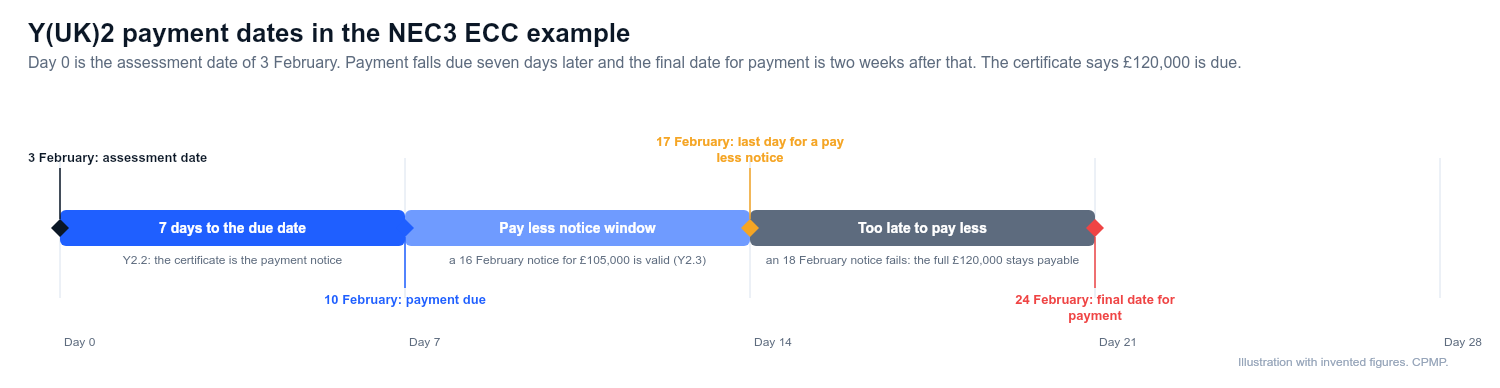
An invented NEC3 ECC job, with no change to the final-date period and no bank holidays in the way.
- Assessment date: 3 February.
- Payment due: 10 February.
- Last day for a pay less notice: 17 February.
- Final date for payment: 24 February.
The certificate says £120,000 is due to you. The Client wants to take off £15,000 for something it says you owe. If it sends a proper pay less notice on 16 February, stating £105,000 and how that was worked out, it can pay £105,000 by 24 February. If the notice goes out on 18 February, it is late, and the full £120,000 stays payable.
Why it matters to you
- The certificate has legal weight. It is the payment notice and states the notified sum, so a late or careless one is more than an admin slip.
- Either side can give a pay less notice, including where you owe the Client money.
- Deductions need a notice. Saying so in a meeting is not enough.
- Suspension is protected. If you suspend properly for non-payment, the effect on you is a compensation event. A wrongful suspension can be serious, so take advice first.
Common slips
- Counting calendar weeks. Day periods skip certain holidays, so dates around Christmas and Easter come out wrong.
- Quoting NEC3 numbers in NEC4 letters, especially Y2.4 for suspension.
- Assuming a Z clause can rewrite everything. The Act sets minimum rules, so unusual payment schedules need a legal check.
- Forgetting adjudication. The Act gives a right to adjudicate at any time, which is why Option W2 normally goes with Y(UK)2.
Related guides
- Pay less notices under NEC
- The NEC payment timeline
- The client missed the pay less notice
- Choosing secondary options
This guide is general information, not legal advice. Check it against your contract.