
Subcontractor reported a compensation event late: can you still claim from the Client?
Two contracts run two clocks. Learn which dates to check, what you can recover upstream and how to reply to a late subcontractor notice.
On this page
Your subcontractor has just told you about an event that happened weeks ago. Before you reply, remember there are two contracts and two clocks.
The short answer
Check your own awareness date and notify the Project Manager (the person who runs the main contract for the Client) now if you are still within your period. A subcontractor being late harms its entitlement under the subcontract. Your claim against the Client rests on two questions: is the event a compensation event under the main contract, and did you notify it within eight weeks of becoming aware of it (61.3)? In the unamended NEC4 forms the subcontract period is seven weeks and the main contract period is eight.
What to do, step by step
- Fix your awareness date. Look at site diaries, emails and meeting notes to see when anyone on your side first knew, not only the date on the subcontractor's letter.
- If you are inside eight weeks, send your own notice upstream immediately. It is a separate notice under 61.3.
- Answer the subcontractor on time. The NEC4 subcontract gives you two weeks (61.4), which is a week longer than the Project Manager's reply period to you.
- Ask whether the event came from an instruction or a similar communication. Where it did, the time bar does not apply at that level.
- Keep the two files apart. The tests, dates and even the facts can differ between contracts.
How it plays out
| Subcontractor | You, upstream | Outcome |
|---|---|---|
| Late | Within eight weeks | You can still claim if the event qualifies. The subcontractor's own costs may not be recoverable, but yours can be assessed |
| Within seven weeks | Late | The worst case: you owe your subcontractor and cannot pass it up, unless an instruction is the source |
| Late | Late | Neither level gets a change, for events that are barred |
| Within time | Within time | Business as usual; send the quotation up using the tighter subcontract periods |
What to record
- Every date anyone on your team learned of the event.
- The subcontractor's notice, its date and how it was sent.
- Your reply under 61.4.
- Your upstream notice and the Project Manager's response.
What not to do
- Do not wait to decide how to answer the subcontractor before notifying upstream.
- Do not pay the subcontractor out of goodwill without thinking. A voluntary payment can be challenged as a cost you did not have to incur, especially on Options C to E.
- Do not assume the Client will accept that your subcontractor's knowledge is separate from yours. Clause 26.1 makes you answerable for subcontractors as though they were your own staff, so expect an argument that your clock began when their foreman first noticed. The contract wording does not settle the point.
When to get help
Take advice from your commercial manager or a lawyer if a large sum turns on whose awareness counts. If your own period has also run out, the guide on missing the eight weeks explains what follows.
Example
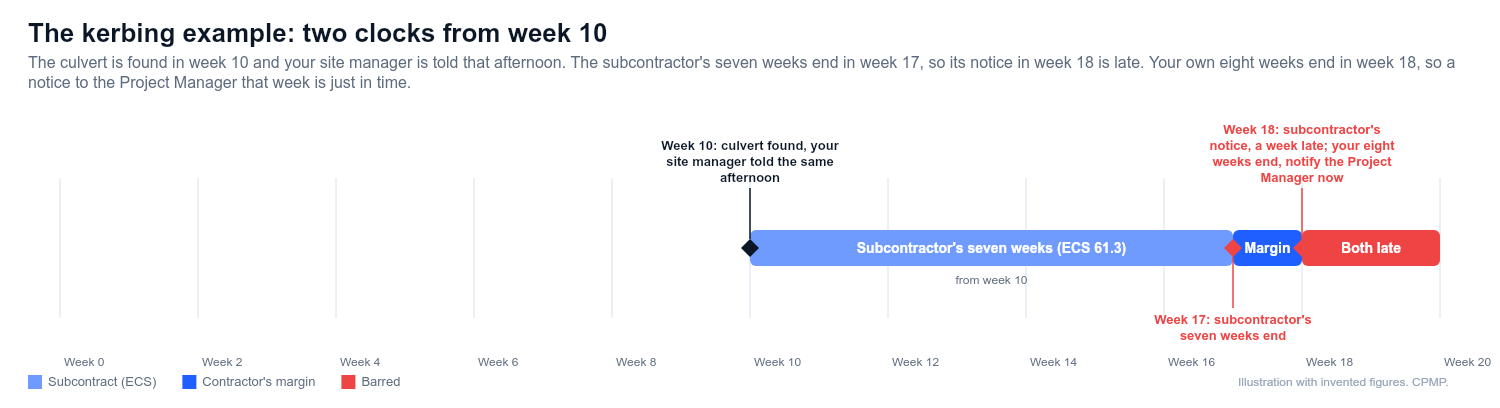
A fictional kerbing subcontractor finds an old culvert in week 10 and mentions it to your site manager that afternoon. Nothing is written down until week 18, which is a week beyond its seven. You count week 10 as your own awareness date, which leaves you just inside eight weeks, so you notify the Project Manager straight away. You reply to the subcontractor that its notice came too late under 61.3 and nothing changes for it. Your own site costs still go in your quotation.
Related guides
- Time bars for subcontractors
- NEC time bars explained
- My subcontractor says it is a compensation event
- Managing NEC subcontracts
This guide is general information, not legal advice. Check it against your contract.