
Hit unexpected ground conditions: what to do under NEC
General guidance on unforeseen ground conditions under NEC: early warning, evidence, notifying a compensation event and why your Contract Data and Scope matter.
On this page
You dig, drill or pile and the ground is not what you expected: rock where there should be clay, water, contamination, an old foundation. This guide is general and written from the Contractor's side. Whether you have a compensation event depends heavily on what your own contract says about the ground.
The short answer
Tell the Project Manager at once and secure the evidence before it is covered up. Then check the compensation event list for physical conditions and compare it with what your Contract Data and Scope say about the ground and what you should have allowed for. Notify within eight weeks of becoming aware (clause 61.3; seven weeks under the NEC4 subcontract) if you think you have an event. No Project Manager instruction caused a ground event, so the time bar applies in full.
What the test looks like
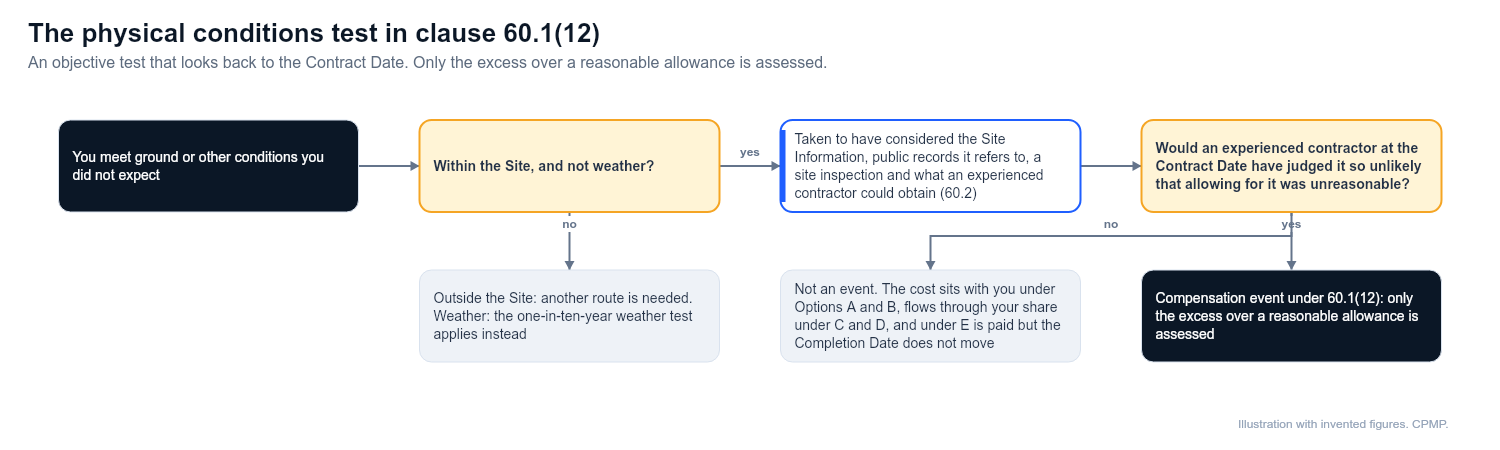
The physical conditions event (60.1(12), the same in NEC3 and NEC4) covers physical conditions within the Site, other than weather, that an experienced contractor would have judged at the Contract Date to have such a small chance of occurring that it would have been unreasonable to allow for them. The test is objective and looks back to the Contract Date: it asks what a competent contractor would have thought, not how surprised your team was. Only the excess over a reasonable allowance is assessed, so the part you should have allowed for stays with you.
Under 60.2 you are taken to have considered the Site Information, the public information it refers to, what a visual inspection of the Site would show, and what an experienced contractor could reasonably expect to have or obtain. If the Site Information conflicts with itself, 60.3 has you assume the conditions that are more favourable for doing the work. Z clauses often amend or delete this event, so read yours first.
What to do, step by step
- Stop and make safe. Protect people and the work. Do not carry on in a way that destroys evidence or creates risk.
- Give an early warning. Tell the Project Manager in writing what you have found and the likely effect (clause 15.1 NEC4, clause 16.1 NEC3). Invite them to inspect before you move on.
- Preserve the evidence. Photograph, measure and sample the ground, with levels and a location reference, before backfilling.
- Compare with the information you were given. Find the ground investigation data, logs, and any statements in the Scope. Note where the actual conditions differ and by how much.
- Check the contract. Read 60.1(12), clauses 60.2 and 60.3, and any Z clause that changes them. Check the Site boundary, because conditions outside the Site need another route, and note that ground softened by rain may be pushed to the weather test.
- Notify the event. Do this within eight weeks of becoming aware. If you are unsure, notify and say why you think it qualifies. A notification that turns out to be unfounded costs less than a missed one. The Project Manager then has one week to decide (61.4); if it is silent, notify the failure, and two further weeks of silence is treated as accepting that it is an event.
- Agree the method. Ask the Project Manager for instructions on how to proceed, and continue to work in line with mutual trust and co-operation (clause 10.2).
- Prepare the quotation. Include cost, time and a revised programme (clause 62.2), submitted within three weeks of being instructed (62.3). If the extent is unknown, ask the Project Manager to state an assumption, such as a rock volume, under 61.6; a later correction is a new event under 60.1(17). See how to prepare a CE quotation.
What to record
- Dated photographs with a scale and location.
- Logs, levels and test or sampling results.
- The ground information you relied on at tender and in the Scope.
- Method statements before and after the change.
- Plant, labour and disposal costs for the additional work.
- Programme extracts showing activities affected.
- Early warnings, instructions and meeting notes.
What not to do
- Do not backfill or cover the ground before the Project Manager has had a chance to inspect.
- Do not assume you have an event because the ground was worse than you hoped. The test is more demanding than that, and if it fails the cost sits with you under Options A and B, flows through your share under C and D, and under E is paid but the Completion Date does not move.
- Do not claim the whole excavation. Only the difference between what you met and what was reasonable to allow for counts.
- Do not rely on memory of what the tender information said. Get the document.
- Do not change the method on your own authority and then ask for payment.
- Do not delay the notification while investigations continue.
- Do not ignore contamination or utility finds, which carry their own legal and safety duties. Take advice.
When to get help
Involve your commercial manager early, because ground events are often contested and the wording of the Contract Data and Scope is critical. Take specialist geotechnical advice if the cause is disputed. Ask a planner to assess critical path effect. Take legal advice if the Project Manager rejects the event and the amount is large.
Related guides
- Compensation events in plain English
- Early warning: do I give one?
- Delay analysis basics
- Avoiding disputes under NEC
This guide is general information, not legal advice. Check it against your contract.