
Pricing a compensation event for work you have already done
How to price a compensation event when the work is finished: what counts as actual cost, what must be forecast, and the evidence to gather.
On this page
You have finished the work, the Project Manager has now asked for a quotation, and you are wondering whether you can simply price what it actually cost. Mostly you can't, because the contract splits the pricing at a particular date.
The short answer
Work out the dividing date first. Cost incurred up to that date is priced as actual Defined Cost (the cost items the contract allows you to charge, listed in its schedule of cost components). Everything after it is priced as a forecast, even if you have since finished it and know the real figure. The Fee is then added to both parts under clause 63.1. This works the same in NEC3 and NEC4.
What to do, step by step
- Find the dividing date. If the event came from an instruction, a notification, a certificate or a changed decision by the Project Manager or Supervisor, the date is the date of that communication (NEC3 lists a corrected assumption rather than a notification). For any other event, it is the date you notified it.
- Check the event has been notified. If not, do it today. An event you knew about but never notified can still run into the eight-week limit in clause 61.3. See missed the eight-week deadline.
- Watch the quotation clock. You have three weeks from the instruction to quote (clause 62.3), or two weeks under the NEC4 subcontract.
- Price the pre-dividing-date work from records. Use the evidence listed below, and only cost types that fall inside the schedule of cost components. See Defined Cost, Fee and disallowed cost.
- Forecast the rest. Base it on what could reasonably be expected on the dividing date, not on hindsight.
- Measure delay on the right programme. In NEC4 (clause 63.5) compare against the Accepted Programme current on the dividing date.
- Strip out anything the event did not cause. The quotation covers the effect of the event, not everything that went wrong in those weeks.
- Include everything. Once an event is implemented it is not reopened (clause 66.3), so there is no second go.
What to record
- Timesheets and allocation sheets showing who worked on the event, with dates and hours
- Plant records: on site, on hire or standing, and the rates charged
- Delivery tickets and invoices, with recoverable discounts taken off
- Subcontractor accounts and amounts due to each
- Dated photographs and diary entries showing how the event affected the work
What not to do
- Do not assume your tender rates apply. Unless the rates have been agreed with the Project Manager (clause 63.2), they do not decide the price.
- Do not put in a group company's marked-up invoice as though it were cost.
- Do not treat finished work as a reason to submit late. Completion does not excuse a late quotation.
- Do not let the Project Manager's request for "just the actuals" go unrecorded. It is often practical, but agree the figure in writing.
When to get help
Bring in your commercial manager if the forecast and real cost differ widely, or if the Project Manager says you failed to warn them (clause 61.5 can reduce the assessment to what a warned event would have cost). A planner can help with the delay assessment, particularly where programme revisions have crossed the dividing date.
Example
A pumping station refurbishment on Option A. The crew finds an undrawn buried chamber on 4 September and notifies on 11 September. The extra work finishes on 25 September. The numbers are invented.
| Period | Basis | Amount |
|---|---|---|
| 4 to 11 September | Actual, from timesheets and plant records | £6,000 |
| 12 to 25 September | Forecast as it looked on 11 September | £14,000 |
| Fee at an illustrative 12% | On both amounts | £2,400 |
| Quotation | £22,400 |
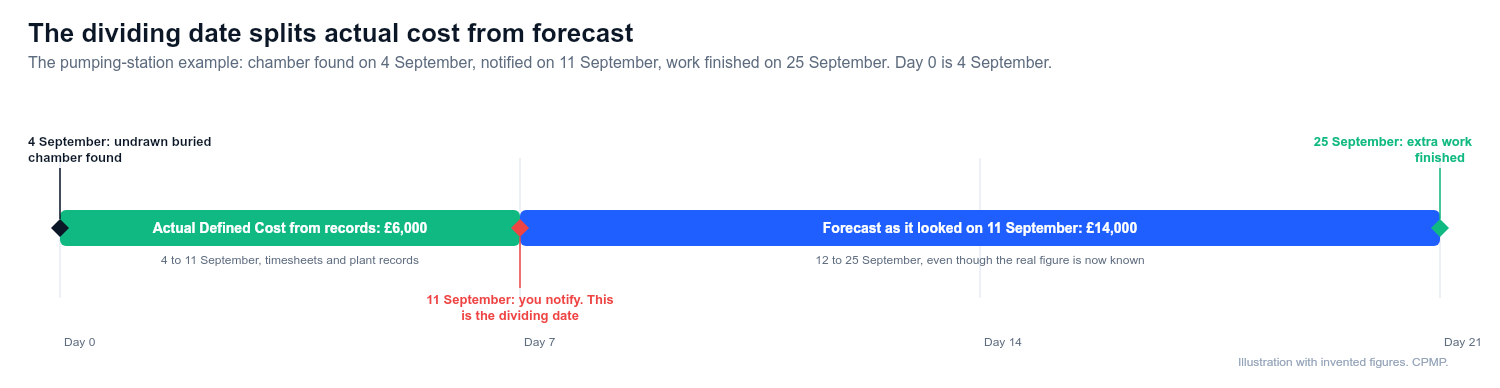
If the real cost of the second period came to £19,000, expect the forecast to be tested against what was reasonably foreseeable on 11 September. If the crew had already hit unusually hard concrete before notifying, that is fair evidence.
Related guides
- Writing a compensation event quotation
- Quotations for compensation events
- Keeping records under NEC
- Working without records
This guide is general information, not legal advice. Check it against your contract.